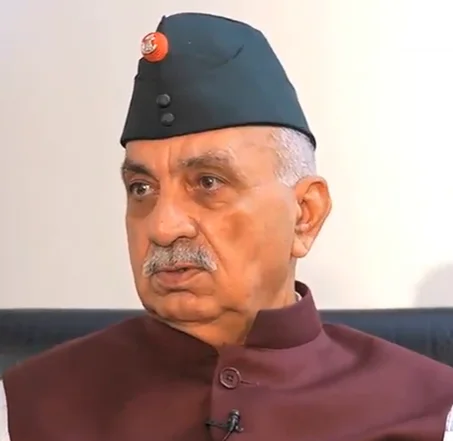
In spite of being a company commander (senior manager), I convinced our team to accept the vision of ‘No loss of life’. Thereafter we planned training, equipping, medical weeding-out and an extended acclimatisation schedule to break the trend. The Universe did the rest.
11 Rajputana Rifles, deployed on the Siachen Glacier from Dec 1998 to May 1999
Army Chief Unit Award, 15 January 2000
President’s Mention in Despatches for me
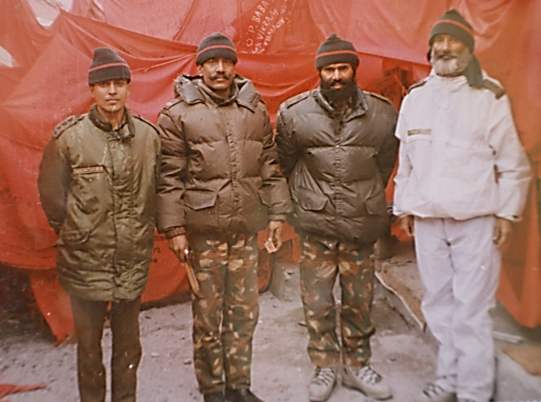
I was a Major (senior manager of 120 soldiers, with weapons and equipment worth a few hundred crores) with ten years of service when I proposed something no one had asked for. My unit, 11 Rajputana Rifles, was to be deployed to the Central Glacier Sector of the Siachen Glacier for a standard six-month tenure, one of the most punishing deployments on Earth. I went to my Commanding Officer, Colonel Anil Bhatia (CEO of 800 soldiers, with weapons and equipment worth a few thousand crores), with an idea: that this tenure, unlike every one before it in fifteen years of this war, should bring all our 800 soldiers home. Not most. All.
I had volunteered to command Delta Company at the Darshak Complex, the highest and most exposed complex in the Central Glacier and, by Base Camp gossip, the one with the worst casualty rate, which was blamed on Pakistan for not allowing enough oxygen at that height! The reality was different: soldiers were being inducted into higher posts with a greater height differential than their acclimatisation allowed. Once that riddle was cracked, several others solved themselves.
So we prepared as if the record were already ours to make: a detailed reconnaissance, physical conditioning built for extreme altitude, and operating procedures drilled until they were instinct.
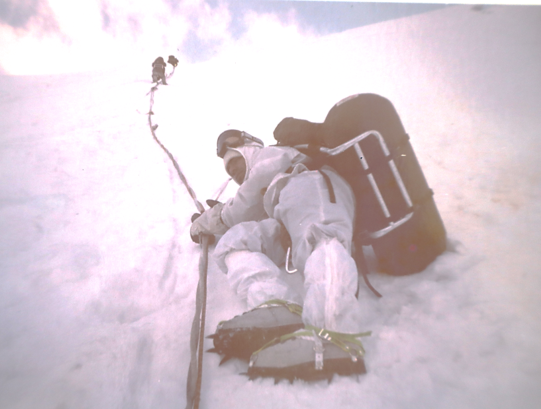
That preparation was tested three times, in exactly the situations we had planned for. First, one soldier developed signs of a brain tumour and was successfully evacuated, as an immobile patient, down the 900-foot ice wall. Second, our satellite post, Pahalwan, took a direct Pakistani artillery shell: not one of my soldiers was injured, while two soldiers from an associated artillery unit, who had not followed our procedures, suffered splinter wounds. Third, and most dramatic: returning to base after our 144-day tenure (norm for each individual was 90 days), 18 of my Darshak soldiers, including me, were caught in an avalanche beneath the 900-foot Darshak Ice Wall. All 18 survived.
Every soldier who went up came back down, making this the first Siachen Glacier tenure in the war’s history to achieve that. It has since become the standard other units are held to, in a place where “success” had quietly been redefined to accept loss.
One belief has followed me out of the world’s highest and coldest battlefield into every high-stakes environment since: winning teams aren’t the ones facing the fewest threats. They’re the ones who diagnosed the real problem correctly, prepared for it precisely, and refused to accept “acceptable losses” as a category at all.
As his Commanding Officer in 11 Rajputana Rifles, I watched Sanjay set a goal nobody had dared set for Siachen Glacier — a tenure with no soldier left behind — and then do the preparation to actually deliver it, in 1998–99. Months later, in Operation Vijay, he helped establish Sub Sector Haneef and was part of the force that captured the Saddle of Point 6,041 and Point 5,590. When Captain Haneef Uddin fell within sight of a Pakistani post, Sanjay volunteered to bring his body back. That sequence — a planner’s mind, a soldier’s hands, and a quiet refusal to leave anyone behind — is exactly who he is.