Research that did not stay on the shelf: each thesis became a strategy on the ground.
Three theses written years apart, each later proven as a strategy in the field.
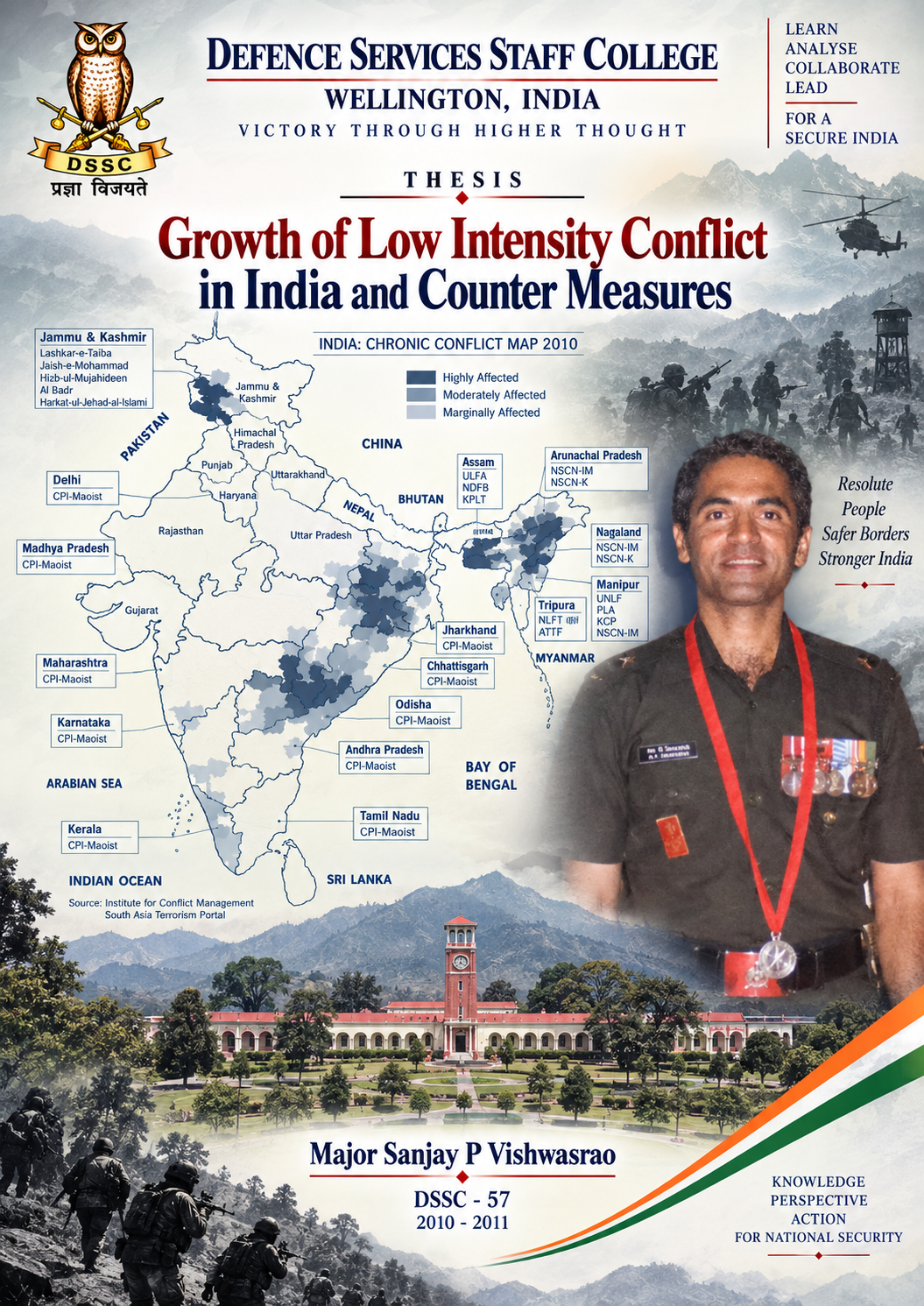
Investigating the roots of insurgency and terrorism
Why do insurgencies and terrorism persist despite sustained security operations? This award-winning thesis examined the underlying causes of low-intensity conflicts in India, looking beyond their immediate manifestations to the social and governance conditions that sustain them. It identified poor governance and the exploitation of weaker and under-represented sections by the powerful as key factors contributing to the continuing appeal of insurgency and terrorism.
The central insight was that lasting peace requires more than defeating armed adversaries; it requires addressing the grievances and structural weaknesses that allow violent movements to retain support.
Research focus: Root causes of internal conflict, governance failures, social exclusion and the conditions necessary for durable peace.

Reframing information warfare: from targeting adversaries to challenging the ideas that sustain conflict
This thesis examined the strategic contest between conventional power and manoeuvre in Fourth-Generation Warfare.
Its central argument challenged the prevailing approach to Kashmir by identifying the idea of azadi—rather than the population itself—as the centre of gravity of the anti-India nexus. It argued that an idea cannot be defeated by force alone: an alternative vision must be communicated more effectively, making information warfare the main effort in addressing the ideological foundations of the conflict.
The thesis extended this reasoning to Pakistan, identifying the Two-Nation Theory as its centre of gravity, recommending information warfare as a principal instrument for winning the contest of ideas and pursuing peace.
These propositions were not confined to academic analysis. I subsequently applied their underlying principles in Kashmir during 2011–2013, in Assam–Manipur during 2015–2016, and again in Kashmir during 2020–2022—using information, narratives and engagement with local populations as components of a broader strategy.
Research focus: Fourth-Generation Warfare, centres of gravity, information warfare, ideological competition and the strategic application of alternative narratives.
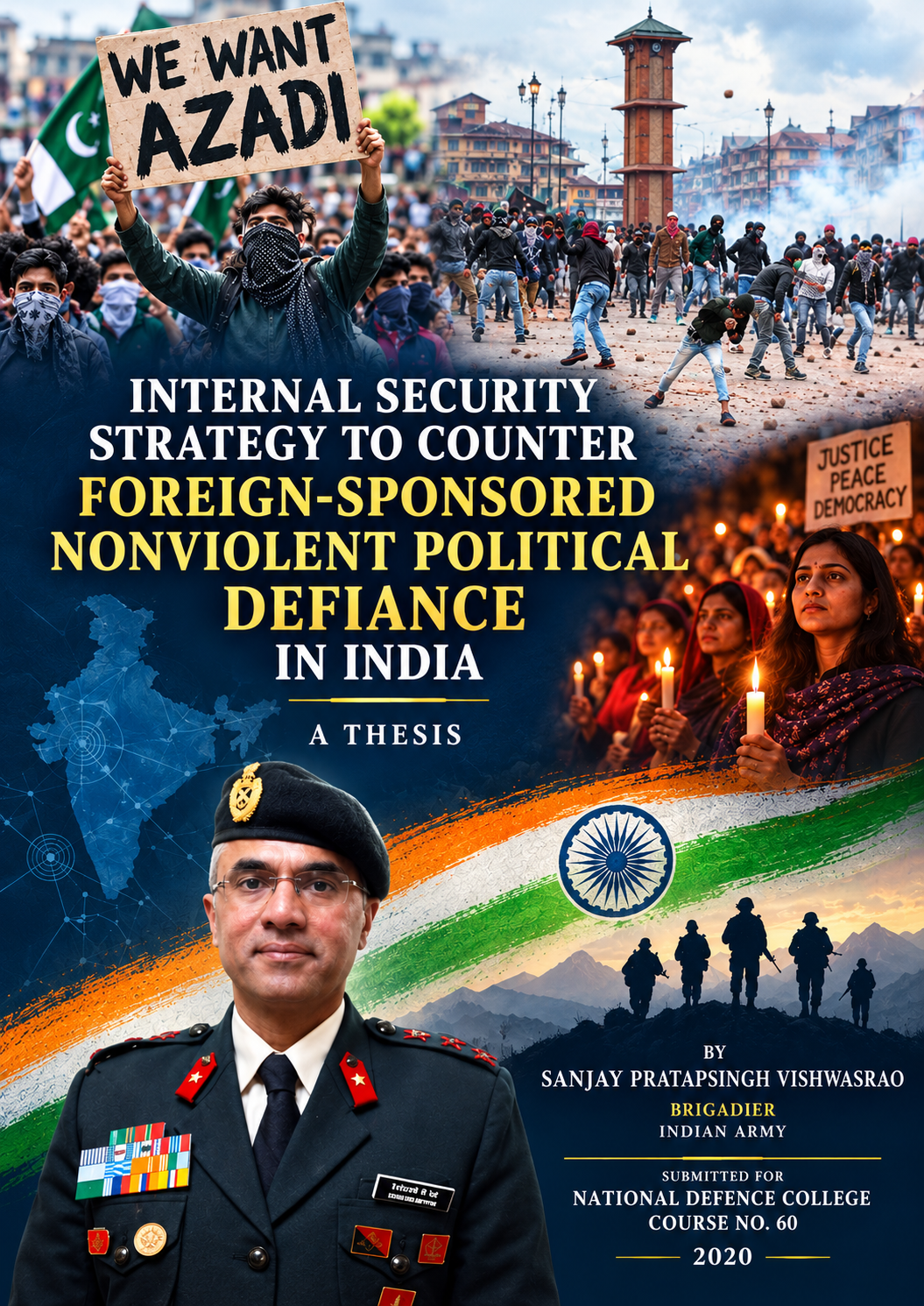
From books to a model to a successful experiment in Assam-Manipur to a Strategy for Bloodless Peace using a new model, The Kashmir Tricolour Revolution
This thesis examined how to counter foreign-sponsored strategic nonviolent political defiance in Kashmir. It advanced a central proposition: the strategic centre of gravity was not merely the terrorists using violence to enforce their objectives, but the idea of azadi itself. Countering that idea, the thesis argued, required an alternative vision—one communicated more effectively, connected to people’s aspirations and translated into visible, credible action.
It also required social engineering. I had read the relevant books while in Srinagar in 2011-2023 to develop my own model for winning peace as a contribution of national security. The model was successfully experimented in Assam-Manipur in 2015-2016 as the ‘All Tribes, One India Tricolour Revolution’.
Knowing that the Abrogation of Article 370 in 2019 had opened a strategic window for peace, I sent the thesis, accompanied by a personal letter, to General Bipin Rawat, then Chief of Defence Staff, and General M. M. Naravane, then Chief of Army Staff. I requested their review and sought an posting in Srinagar to put the proposed strategy into practice. When I subsequently met General Rawat for an interview for the National Defence College’s official magazine in 2020, I reiterated my request in person.
My subsequent appointment in Srinagar provided the opportunity to translate these strategic ideas into practice. During 2020–2022, I led initiatives that became part of what I describe as the Kashmir Tricolour Revolution—an approach centred on national identity, public participation, cultural engagement and the contest of ideas.
The significance of this thesis lies in the journey it represents: from investigating the nature of political defiance, to proposing a strategy, to seeking the responsibility to implement it. It reflects my conviction that strategic research must do more than explain a problem; it should help shape practical responses to it.
Research focus: Nonviolent political defiance, centres of gravity, information warfare, national identity, strategic communication and the translation of theory into practice.
“I QUESTIONED, RESEARCHED AND WROTE TO UNDERSTAND WHY CONFLICTS ENDURE AND HOW PEACE CAN PREVAIL. GUIDED BY DHARMA, I OFFER THESE FINDINGS SO THAT FUTURE LEADERS MAY THINK DEEPER, ACT WISER AND SERVE BHARAT BETTER.”


