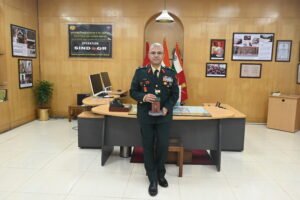
SENA MEDAL (TWICE) (VETERAN)
“Yadā yadā hi dharmasya glānir bhavati Bhārata,
Abhyutthānam adharmasya tadātmānam srijāmyaham.”
— Bhagavad Gita, Chapter 4, Verse 7
Whenever dharma declines and adharma rises, I manifest myself.
Those who dare to dream the impossible in service of dharma need not carry it alone. The Universe itself becomes their ally.
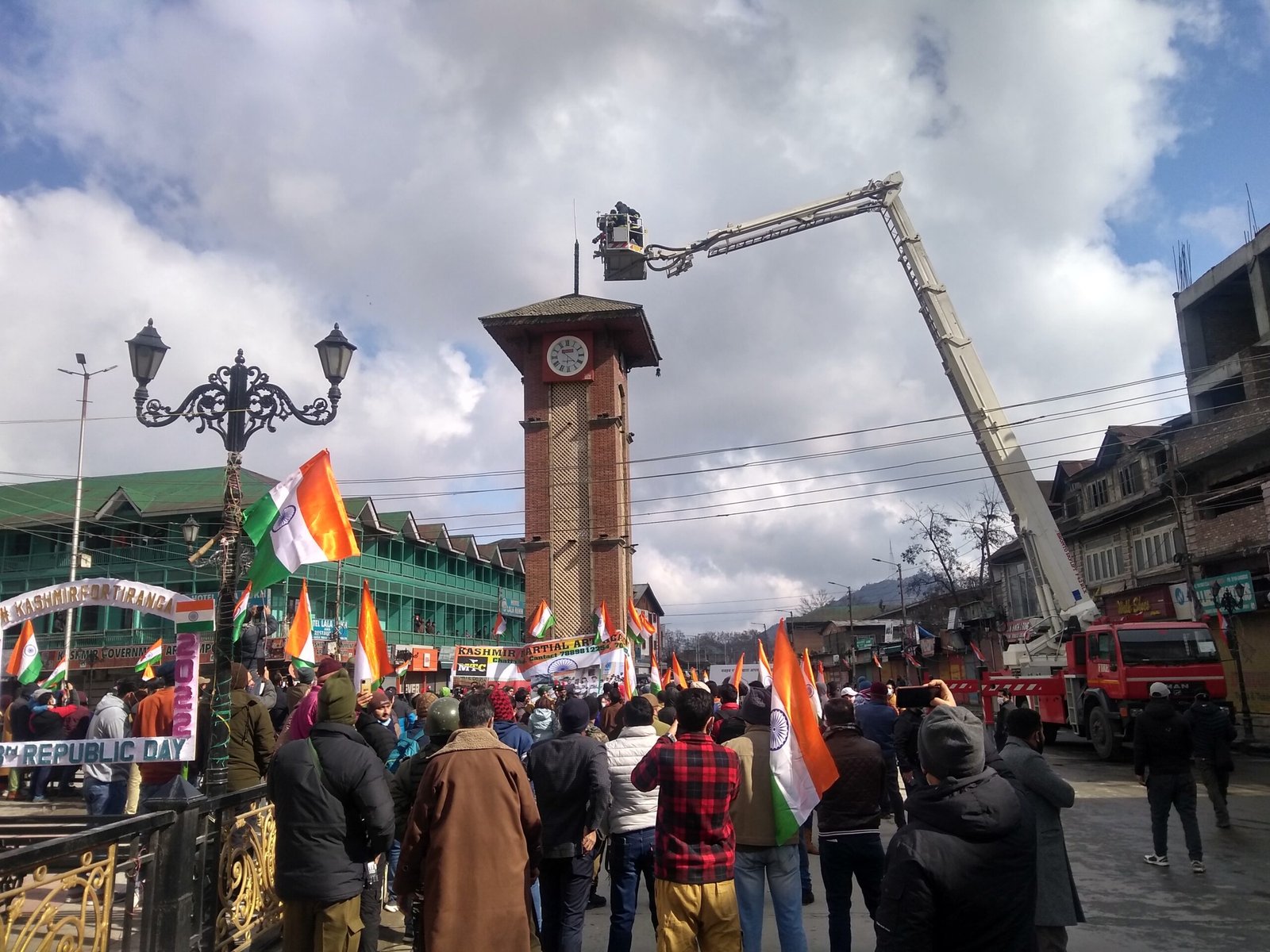
Before we begin this story, you must understand what Lal Chowk means. Not geographically. Emotionally. Historically. Spiritually.
Lal Chowk — Red Square — takes its name from Moscow’s iconic plaza. It was named by the communist-leaning founders of the National Conference who dreamt of a socialist Kashmir. Today it is the beating heart of Srinagar: the place where the clocks are set, the deals are struck, the speeches are made, and the kahwa or tea is drunk before all important things begin. If you want to know what Kashmir is feeling on any given day, stand in Lal Chowk and feel.
In 1948, Prime Minister Jawaharlal Nehru stood here and unfurled the Indian Tricolour, welcoming Kashmir into Bharat. Sheikh Abdullah, the Kashmiri politician, stood beside him and declared in Persian: ‘Man Tu Shudam, Tu Man Shudi’ — ‘I became you and you became I; none can say we are separate.’ [1] Two leaders. One square. One promise.
Then came the darkness. It began descending in 1947 itself, but we will leave that for a historical essay.
In the 1990s, as Pakistan’s proxy war tore the Valley apart, separatist terrorists unfurled the Pakistani Sabz Parcham — the green-white crescent-and-star flag — atop this very Clock Tower at Lal Chowk in the heart of Srinagar, and also of Kashmir Valley. Pakistani flags flew where Prime Minister Nehru had once held the Tricolour. The message was unambiguous: this Square, this City, this Valley — is no longer yours. [2]
After 5th August 2019, not a single separatist demonstration or Pakistani flag hoisting occurred at Lal Chowk. But neither had any Kashmiri — not one local resident, not one J&K citizen — ever walked voluntarily up to that Clock Tower and hoisted/ unfurled the Tricolour of their own accord. Every previous attempt had come from Indians from other states: escorted by security forces, under threat, under curfew. None had placed our Tricolour there with a free heart. [3]
That was the real challenge. Not for us to hoist/ unfurl our Tricolour at Lal Chowk. But to have Kashmiris hoist/ unfurl it themselves. Freely. From love. From choice. From the conviction that our Tricolour was theirs.
That distinction is everything. That is the Tricolour Revolution.
“The goal was never for us to fly to Srinagar from other parts of Bharat and plant a Tricolour. The goal was for Kashmiris to do it themselves — because they wanted to. A Tricolour planted by force is a provocation. A Tricolour raised by a people’s own hand is a revolution.”
Rewind to October 2014. I had just walked out of South Block in New Delhi after meeting Major General VG Khandare to request a posting to Kashmir in my next rank of brigadier. He assured me of a ‘counter-insurgency posting.’ I left his office with a smile. A few steps later, the smile faded — replaced by a vague, uncomfortable feeling that I was about to be sent to the wrong part of Bharat. As a to-be-promoted Brigadier, I wanted Kashmir i.e., ‘counter terrorism’. I sensed ‘counter insurgency’ meant Northeast instead. I smiled, decided not to challenge destiny and continued to walk out of South Block, back to Pune, my city of current posting.
I did not know, standing that day on the South Block pavement, that I was being walked — step by careful step, posting by posting, country by country, year by year — toward a moment on a winter morning in Srinagar that would make a grown Major General cry in public, in front of 300 Kashmiris, while wearing a brown woollen-tweed phiren (Kashmiri traditional winter overcoat).
Babaji and Guruji Naushir did not tell me this. They never do. They simply arrange things. And then they wait, with what I can only describe as supreme cosmic patience, for you to catch up. They do not interfere in our free will. They only arrange the stage. We have to find the courage to walk on to it and then, on it.
This is the story of how TadEkam Foundation entered the domain of national security seva. And how one question from Guruji Naushir — asked twice to my wife Sanjeevani, not even to me — changed the history of Srinagar, and of Kashmir and Bharat.
For readers unfamiliar with TadEkam: we are a community of householder-sadhaks — ordinary working people with families, loans, health issues and desk jobs — who walk a spiritual path rooted in the teachings of Mahavatar Babaji, the deathless Himalayan Mahayogi, through our Guru, the late Guruji Naushir. Our current Spiritual Guru is Swami Dattapadanandji. We believe that seva — selfless service — is itself the highest form of spiritual practice. This blog is evidence that this belief is not theoretical.
Every great seva begins with a seed planted years before you know it is growing.
Mine began in 2011–12 (may be much earlier), when as a Colonel I helped Lieutenant General Ata Hasnain, then Chinar Corps Commander in Srinagar, develop what became his celebrated ‘Hearts Strategy’ — ‘My Heart Is My Weapon’ — for winning peace in Kashmir through people-centric engagement rather than force alone. [4] The idea was simple and radical: to win Kashmir, win Kashmiri hearts. Not with guns. With genuine care. Ironically, in 2006-2008 in Lolab, our vision for our Rashtriya Rifles unit had been: “People of Lolab have voted for India in Plebiscite 2010.” The seed called ‘me’ may have been planted in 2005 (may be earlier). Who knows?
Around the same time, we had begun developing what I called the ‘Tricolour Revolution Strategic Model’ — a framework for bloodless peace built not on military operations but on rebuilding the emotional and constitutional bond between Kashmiris and Bharat. The end-goal: Kashmiris raising the Tricolour at Lal Chowk themselves, by choice, with joy. I first mentioned this idea to Guruji Naushir in 2016.
He ignored it completely.
I felt bad. I went home and ate my feelings, probably.
But Guruji, I would learn over and over again, does not ignore anything. He files things away in a place that is not a drawer, but more like a divine dispatch system that delivers only at the exact right moment.
October 2014. The next morning after the South Block meeting with Major General VG Khandare, back in Pune, my phone rang. An old friend from Assam Rifles Headquarters in Shillong: “Sir, the Army has recommended your name for Assam Rifles. I can swing it both ways — Yes or No — please let me know.” He had played this role once before in my life. In 2005, he had nudged me to lead a Rashtriya Rifles unit in Lolab, Kupwara, North Kashmir — a posting that earned me a gallantry award, led to my first book, ‘Lage Raho Leadership’ (2015), and sowed the seed of this blog. [13] I agreed to his suggestion of the Haflong Assam Rifles Sector, purely because of his previous track record of sending me exactly where I had to go, without either of us knowing why.
This, I have since understood, is how Babaji operates. Through completely ordinary phone calls between ordinary people, at critical moments in a life. The divine machinery has excellent telephone manners.
The Assam Rifles posting turned out to be a full-dress rehearsal for Kashmir 2020-2022. My area of responsibility chiefly covered Dima Hasao District in Assam and Jiribam District in Manipur — complex, multi-ethnic, conflict-affected demography requiring exactly the kind of patient, people-first social engineering my (Babaji’s & Guruji’s) Tricolour Revolution Model was built for.
Lieutenant General Bipin Rawat was my Dimapur Corps Commander —second reviewing officer in my chain of command. We had useful history: when he was a Brigadier in Kashmir’s Sopore, I had been commanding my Rashtriya Rifles unit in nearby Lolab. Our common boss, Major General Rajinder Singh of Kilo Force, used to tell him: “Ask your officers to learn from Sanjay.” I wish I could say I handled this with complete humility. I cannot, as this is General Bipin Rawat’s own statement to me.
In 2012, Lieutenant General Ata Hasnain had asked me to explain Pakistan’s and Hurriyat Conference’s ‘Kashmir Intifada Strategy’ — drawn from Gene Sharp’s ‘From Dictatorship to Democracy’ [5] and Malcolm Gladwell’s ‘The Tipping Point’ [6] — to a group that included a newly promoted Major General Bipin Rawat. He listened carefully then. So, in Haflong in 2015, when I presented the Tricolour Revolution Model using the same strategic frameworks and proposed a trial for a peaceful end-state of ‘All Tribes, One India,’ General Rawat gave it the thumbs up. We ran the experiment. We succeeded.
I was quietly very happy with myself. I was also completely unaware that Babaji was simply clearing his throat before the main speech.
In 2016, I was selected through a competitive interview panel as India’s Defence and Military Advisor at the Indian High Commission in Islamabad. I had not made the cut in two earlier foreign posting selection interviews as a colonel for Turkey and Iran.
Much later, I remember meeting a batch-mate who had also been a candidate for this same interview panel. His wife told me cheerfully: “We did an Akhand Paath at the Gurudwara to pray we would not be sent to Pakistan.” I laughed for a long time. I am still laughing.
To protect his disciple before dispatching him into the lion’s den, Guruji Naushir fast-tracked my Deeksha — the spiritual initiation that had not yet come to me despite being under TadEkam’s umbrella since 2014. My wife Sanjeevani was magnificently irritated: “How can Sanjay, who does not even do sadhna properly, get Deeksha so early?” Guruji smiled. He knew exactly what he was doing.
Now Sanjeevani and I, and our entire TadEkam Family knows: Seva is also Sadhna.
September 2017 to October 2019 in Pakistan prepared me in ways no Army course/ training could. I picked up Urdu. I read the Quran. I had already begun studying Political Islam in Kashmir under Lieutenant General Hasnain’s tutelage since 2011. By the time Article 370 was revoked on 5th August 2019, I understood the ideological, demographic, and emotional terrain of Pakistan and Kashmir as well as their geographies — including the deep and complicated relationship of Kashmiris with the idea of ‘Azadi’ and with ‘Two-Nation Theory’ of Pakistan. [7]
I returned to Bharat in October 2019 and immediately asked Guruji to let me go to Kashmir. 370 had gone. The Tricolour Revolution’s time had come.
He ignored my request. Again.
(I want to emphasise: Guruji ignoring me is not a passive thing. It is an active spiritual act. When Guruji does not respond, the Universe is still working. You are just not ready yet. Or the conditions are not ripe. Or — as I would later understand — one more piece of the plan has yet to fall into place.)
I spent 2020 attending the National Defence College Course in Delhi, preparing a formal thesis on the Tricolour Revolution in Kashmir for Peace. In the midst of the COVID Pandemic in August 2020, I accosted — yes, accosted — Guruji with the hard copy of my thesis and a laptop carrying its PowerPoint presentation. He did not look at the thesis or the laptop. He did not have to. He simply turned his head slightly skyward, closed his eyes for a brief moment, and agreed. He warned, however, that complete peace in Kashmir would take longer than my remaining service in uniform. I was ready to lay even just the foundation. Then he said the words that changed everything:
“Meet General Bipin Rawat. But first, send an official letter requesting a posting to Kashmir to implement the Tricolour Revolution for Peace.”
Guruji had already arranged the meeting. I was the student editor of Kuutneeti, the National Defence College journal. At an editorial board meeting, I suggested interviewing India’s first Chief of Defence Staff, General Bipin Rawat for our main report. It was approved. And, I was selected to take the interview. The interview was scheduled for the latter half of September 2020. I despatched my formal posting request to General Rawat’s office and to Army Chief General MN Naravane [8] simultaneously with the interview request, so that it arrived on his desk before his office had even confirmed the interview date.
In parallel, I revisited Lieutenant General VG Khandare, who had in 2014 quietly posted me to Haflong, Assam instead of Kashmir. He had since become my boss in Pakistan as Director General Defence Intelligence Agency. Later he became the Military Secretary to the National Security Council Secretariat, and thereafter Advisor to the Raksha Mantri. In one of our meetings in 2020, he admitted that his 2014 decision to send me to Haflong, Assam had been deliberate — he had developed a soft corner for tribal communities there, having served in Haflong himself during the peak of inter-tribal violence. He was happy and proud that the Tricolour Revolution had brought peace for those warring tribal communities. At that moment I realised he too had been an instrument of Babaji and Guruji. I stopped calling the model ‘my’ strategy and started calling it ‘ours.’ He liked that. He owned our Strategic Model. He became a collaborator.
After the Kuutneeti interview concluded, I requested a few minutes to discuss my Kashmir posting request. General Rawat gave the thumbs up for the Tricolour Revolution Strategy. Then he did something extraordinary: he got me posted to Srinagar Sub Area — which meant the Clock Tower at Lal Chowk fell directly within my area of responsibility as Commander of Srinagar Sub Area.
Before leaving his office, I slipped in two requests. First: direct my superiors — Lieutenant General BS Raju in Srinagar, Lieutenant General YK Joshi in Udhampur, and General Naravane in Delhi — to embrace the Tricolour Strategy and support its implementation. Second: give me six years on this mission. He committed to three years, in line with his own remaining tenure. I thanked him and walked out the happiest human on earth.
I reported everything to Guruji. He said: “Get ready for Kashmir.”
Sanjeevani and I reached Srinagar in December 2020. Our official residence: Bungalow No. 5 on the famous — at that time, infamous — Gupkar Road, at the foot of Lord Shiva’s temple on Shankaracharya Hill. Guruji had arranged the posting and the house. I was simply the instrument.
Peace does not come from one person’s brilliance. It comes from the right people being in the right places at the right time — which is to say, it comes from Babaji’s sankalpa working through many willing instruments. I want to honour the six officers without whom 26 January 2022 would never have happened.
Lieutenant General Ata Hasnain (now Governor of Bihar) taught me the fundamentals of information warfare, of political Islam, and of the revolution of the heart. Without his tutelage in 2011–12, I would have had no framework to work from.
Brigadier (later Lieutenant General) AL Chavan gave me the space to learn under General Hasnain, gave me Gene Sharp’s book ‘From Dictatorship to Democracy’ to investigate, and later selected me as India’s Defence Advisor to Pakistan — the posting that completed my preparation.
Lieutenant General VG Khandare, who — as I later understood — had been Babaji’s instrument in 2014, sending me to Haflong for my Northeast rehearsal. He then championed the Tricolour Revolution Strategy in Delhi and went on to support my initiative of Delhi’s National Cadet Corps Seva for Maa Yamuna’s revival and now in 2026, TadEkam’s initiative of Mother Godavari River’s Seva.
General Bipin Rawat, India’s first Chief of Defence Staff, gave the strategic blessing, the institutional endorsement, and the posting to Srinagar Sub Area that made everything possible. He too had been an instrument of Babaji and Guruji Naushir. He was tragically killed in a helicopter crash on 8th December 2021 — just weeks before the morning for which he had set the stage. [8] Standing at the Clock Tower on 26 January 2022, I thought of him most of all.
Lieutenant General BS Raju, former Chinar Corps Commander and then Director General Military Operations, was my first boss in Srinagar in 2020–21. We had war-gamed the Lal Chowk Tricolour event together in March 2021 — taken a sankalpa (a sacred resolve) to work to make it happen. When I messaged him on the night of 24th January 2022, he responded with immediate happiness. His support gave the operation its institutional spine.
Lieutenant General DP Pandey, Chinar Corps Commander during the operation, was the man whose quiet backing was essential at every stage. The 100-feet Tricolour at Haer Parbat on 15th August 2021 had been my (Guruji’s) idea, executed magnificently under his command. [9] He and Mrs Usha Pandey were the subjects of the first-ever selfie taken at Lal Chowk lit up in Tricolours on the same Independence Day. This selfie went viral across Bharat making the Tricolour lit Clock Tower of Lal Chowk Kashmir’s main tourist attraction. He understood exactly what 26th January 2022 meant. My first call after our bullet-less ‘recapture’ of Lal Chowk was to him.
Babaji puts the right people in the right chairs at the right time. What the rest of the world calls coincidence, sadhaks call nishkam seva — selfless service working through the Universe itself.
The year 2021 was a year of planting Tricolours. Literally.
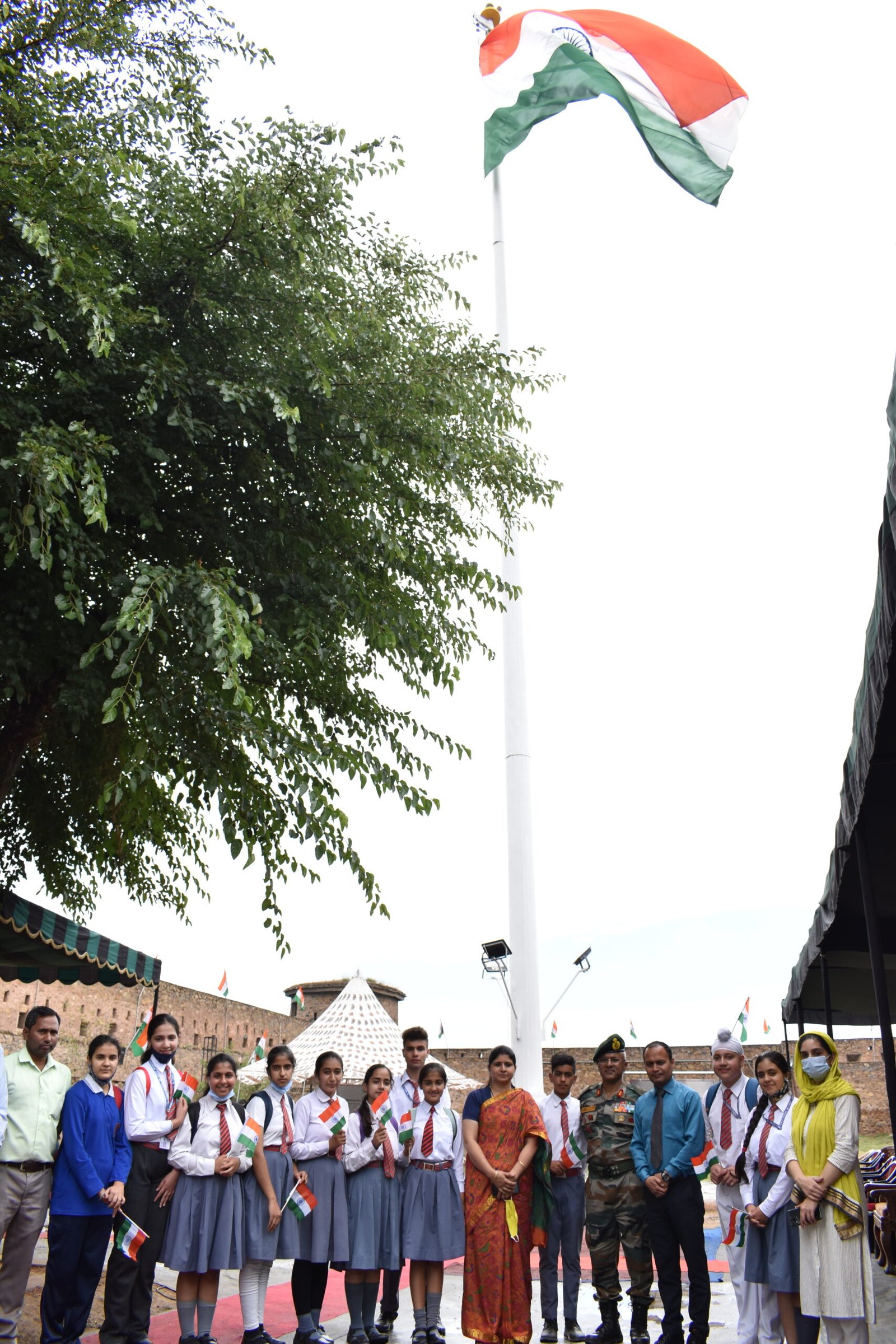
On 15th August 2021 — India’s 75th Independence Day — a 100-feet-tall Tricolour was raised at Shakti Peeth, Haer (Hari) Parbat Fort, in the heart of Srinagar. The concept was mine (Guruji’s); the execution was magnificent, involving the Flag Foundation of India led by Shri Naveen Jindal, the J&K Government, Central Reserve Police Force, and the people of Kashmir. Lieutenant Governor Shri Manoj Sinha dedicated the Tricolour. Lieutenant General DP Pandey and Shri Naveen Jindal were present, along with Divisional Commissioner Shri Pandurang Pole and many of our nationalist Kashmiri friends. [9]
Haer (Hari) Parbat is not an ordinary hill. Centuries ago, according to Sanatani lore, Lord Shiva sent his consort Goddess Parvati in the form of a pigeon (haer in Kashmiri) to slay the demon Jalodhbhava in the primordial Satisar Lake — the lake that became the Kashmir Valley. The pebble She dropped to kill the demon is said to have grown into Haer Parbat itself, with Jalodhbhava crushed under it. This time, the pebble was a 100-feet-tall Tricolour Mast. And the demon being slain was seventy-five years of separatism.
Babaji, I have noticed, has a deeply satisfying sense of theatre.
A story worth adding here. The three 33-feet long pieces of the 100-feet tall mast are normally erected using one-two cranes. It is a thirty minutes job. There was no way for cranes to reach Haer Parbat’s top. So, we had to erect the mast manually, using pullies and chains. Technicians of two State Government Departments refused to help us — electricity and public works. One of these teams fled Haer Parbat mid-way. Overhearing our officer discuss his predicament somewhere in Srinagar, an Airtel mobile tower installation contractor from Uttar Pradesh (Central India) volunteered to help. He and his team of three young Muslim men from Uttar Pradesh completed erecting the mast at 6 pm on 12th August 2021, giving me a practical class on physics. I stood watching whole day, while chanting our Guru Mantra, as the pullies, iron chains and physical strength of our Kashmir friends and soldiers defied gravity successfully.
By late January 2022, I had been in Srinagar for over a year — a full year of the Tricolour Revolution: meetings with Kashmiri youth, community outreach that included cleaning the Dal Lake and the Jhelum River, cultural events, installing 40 plus permanent Tricolours in office buildings of government departments in Srinagar City and the slow, patient work of rebuilding bridges that had been deliberately burned over decades.
On 21st January 2022, Guruji Naushir — sitting comfortably in Pune, far from the Srinagar winter, watching events unfold from wherever Gurus watch from — asked my wife Sanjeevani one question:
“What is Sanjay doing for 26 January (2022)?”
Sanjeevani called me. I gave her an honest answer: the winter was severe; and critically, as per our strategy, I was not to hoist the Tricolour myself — our Kashmiri friends had to find the courage to do so. I could not manufacture spontaneity. I let it pass.
Guruji did not let it pass.
On 23rd January, he asked Sanjeevani the exact same question again. She called me immediately with a warning in her voice: “Expect something. Guruji has asked the same question twice.” When a Guru repeats himself, the Universe is knocking, not suggesting. I became ALERT.
9:30 pm, 23rd January 2022. My phone rang. Young Shri Sajid Yousuf Shah. My first thought: a 9:30 pm call in Kashmir is generally a distress call. “Hope all is well?” I spoke. His reply: “All is well, Sir — but Sahil and I would like to come over now. For your famous Gupkar Coffee.”
The coffee arrived. They sat across from me with that specific expression that means someone is about to say something they have been building up to for a while. Then came the second question — and this one was not Guruji’s:
“Sir, we want to hoist the Tricolour atop Ghanta Ghar at Lal Chowk on Republic Day. Will you help us?”
I thought exactly one thing: Guruji has sent them. They have no idea about this even today.
Two questions. One from Guruji, asked twice. One from Sajid and Sahil. That is all it took to set in motion the operation that changed the history of Srinagar, Kashmir and Bharat (and of Pakistan too). I could not wait for the coffee to be finished. Republic Day was just two days and a few hours away.
We drove the ten minutes to Lal Chowk — me in civil dress, with a single buddy (bodyguard) with a concealed pistol. After a twenty-minute preliminary discussion at the Clock Tower, I sent them both home and returned to 5 Gupkar Road for an excited, sleepless night.
The next morning, I met Divisional Commissioner Shri Pandurang K. Pole, IAS, and requested a fire-fighting aerial ladder platform for the flag hoisting. I then briefed Lieutenant General DP Pandey. Late in the evening, I messaged Lieutenant General BS Raju in Delhi — we had war-gamed exactly this scenario in March 2021, taken a sankalpa that we would work to make it happen. Now it was.
The most important call of the entire operation was to Sou Manhsa Bashir, Taekwondo Coach, to whom we had allotted a shed at the unused Chattabal Military Farm for her Muzaffar Taekwondo Coaching Academy. She had planned a Tricolour Taekwondo display for Army soldiers in Badami Bagh Cantonment on Republic Day. I asked if she would bring the children to Lal Chowk instead. She agreed immediately — and doubled the number of her students from 50 to 100. Transport and a night halt in the Army Transit Camp, complete with dinner, were arranged. The children loved their first-ever stay in an Army camp.
That night, Sajid, Sahil, Major Aditya, Colonel Luve, and I met at Lal Chowk at 11:30 pm — deliberately late to avoid attracting attention — for a full rehearsal with the fire-fighters and their aerial ladder platform. I explained the historic significance of what we were attempting and asked everyone to keep it absolutely silent until the Tricolour was actually up. Well past midnight, after Sajid and Sahil left, we three Army officers got into a huddle to plan the entire operation, including security, photographic and videographic coverage, social media marketing, and most importantly contingency plans which included two alternate ways of reaching the top of the clock tower in case the fire-fighters developed cold-feet. For us, it was an ‘attack’ plan which had to succeed like none had before. I concluded our meeting with: “All Eyes will be on Lal Chowk”.
We kept our side of the bargain about radio-silence of our plan. But Sajid and Sahil leaked the information to their journalist friends in Delhi-Noida. It became breaking news. TV studios in Noida went berserk overnight. I wondered briefly whether we were now under pressure to perform. Then I felt Babaji and Guruji smile: Go With The Flow.
Flashback: Our first public Tricolours in Kashmir had received similar unplanned media attention on 26th January 2021. Tricolours put up by our nationalist Kashmiri friends on snow covered Dal Boulevard between 7am and 9am got compared by all news channels with farmers raiding Red Fort in Delhi and installing the Nishan Sahib (Sikh religious flag) in proximity to our Tricolour the same afternoon.
And that is how our hashtag #TricolourAtLalChowk was enthusiastically outpaced by Republic TV’s Shri Arnab Goswami’s competing hashtag #TirangaAtLalChowk. I am told the thought is what counts. We graciously adopted #TirangaAtLalChowk.
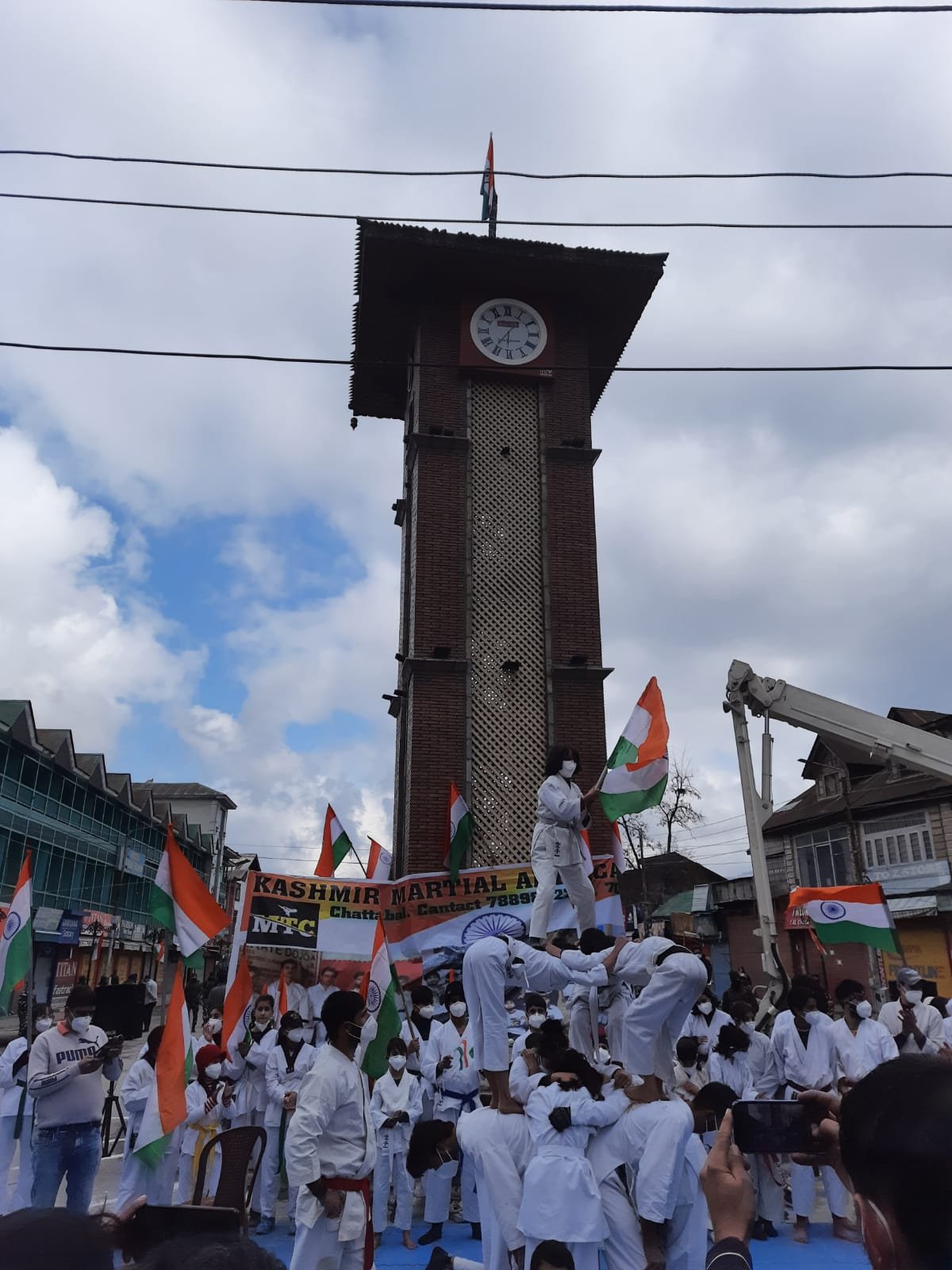
At 7:30 am on 26 January 2022 — Republic Day, India’s 73rd — our Tricolour was hoisted/ unfurled atop the Clock Tower of Lal Chowk, Srinagar, by two Kashmiris: Shri Sajid Yousuf Shah and Shri Sahil Bashir Bhat. For the first time in the history of independent Bharat, Kashmiris themselves walked up to that Clock Tower and raised our Tricolour — flag of their own Nation — of their own will, with their own hands, with joy on their faces. [10]
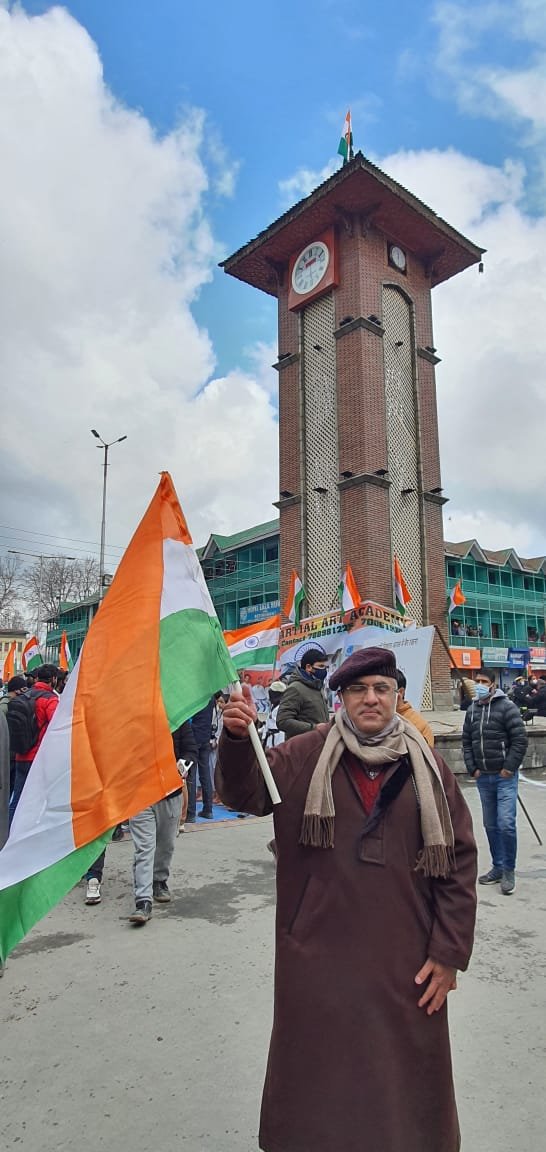
Three hundred Kashmiri citizens stood below. Sou Manhsa Bashir’s hundred Taekwondo children, in crisp white uniforms, formed a human pyramid that made the event look grand. The National Anthem was sung. Every voice.
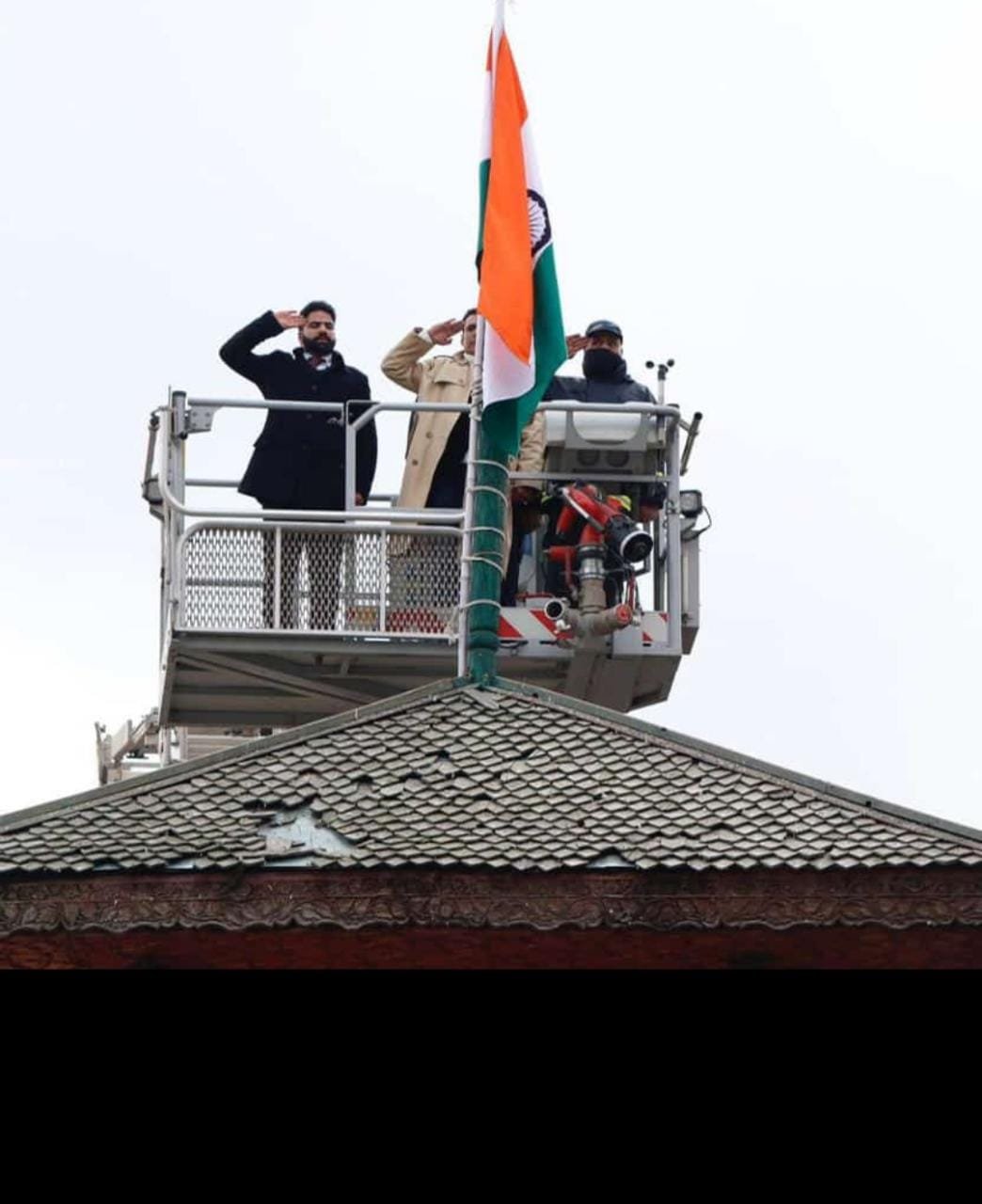
Sahil Bashir said afterwards: “Since independence, we have only seen Pakistani flags hoisted here, raised by Pakistan-sponsored elements who wanted to disrupt the peace of the Valley. Since the abrogation of Article 370, we can see many changes on the ground. We do not want Pakistani flags. We want peace and development.” [10]
I was standing among them in my brown woollen-tweed phiren. Not in Army uniform. Tears streamed down my cheeks. The sun rose in a clear winter sky — sharp, cold, and extraordinarily beautiful — as if it had arranged to come out that one morning for this single purpose. The phiren felt warm. Srinagar felt different. Kashmir felt like the Firdaus — the Heaven — it was always said to be. (“Gar firdaus bar-rue zamin ast, hami asto, hamin asto, hamin ast” — If there is paradise on earth, it is here, it is here, it is here.)
The last time Kashmiris had freely raised the Tricolour at this square was 1948, when Nehru and Sheikh Abdullah stood together. That was 74 years before. Eleven years of planning — most of it not looking like planning at all, but looking like postings, and phone calls, and a Guru ignoring a very good idea — had led to this moment.
#TirangaAtLalChowk reached 2.58 crore impressions on what was then still Twitter. I would like to thank the current Chief Minister for helping make it so viral.
As per Guruji Naushir’s teaching, this is why and how seva succeeds: “If done with Saburi (patience), with Shraddha (faith and devotion), and with the spirit of Nishkam Seva (selfless service) and Ahankarhit Seva (egoless service).” It is a tall order- patience, devotion, selflessness and free of ego. I am still learning. Each day I pray to God to grant me more of these so that I can be a clear channel of Babaji and Guruji Naushir
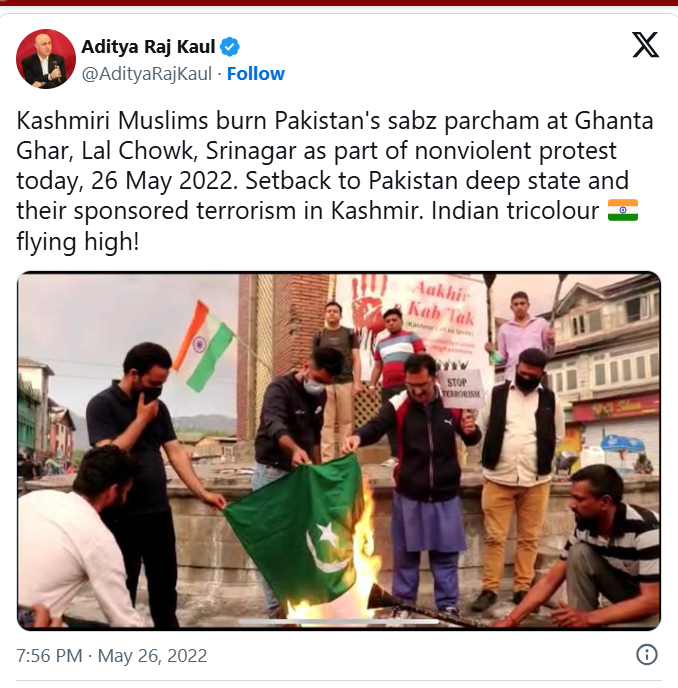
The sequel came four months later. In May 2022, at the very same Clock Tower of Lal Chowk, Kashmiris burnt the Pakistani flag — the Sabz Parcham that had once flown there in triumph during the dark years of the 1990s — in public protest against terrorism and the killing of an innocent citizen. [11] The same ground where the enemy’s flag had flown was now the place where Kashmiris themselves consigned it to flames.
Journalist Shri Aditya Raj Kaul who tweeted this and Colonel Rajeev Raina, both natives of Kashmir played a vital role in the Tricolour Revolution for Peace for Kashmiris. While I have moved on — due to Army postings of two years — being sons-of-the-soil, they continue their efforts.
In the 1990s, terrorists had unfurled the Sabz Parcham at Ghanta Ghar in celebration of their treacherous agenda. What Kashmiris did at that same spot in May 2022 had, as New Bharati reported, ‘immense sentimental value among nationalist Kashmiris.’ [11]
Activist and former politician Sou Shehla Rashid — a Kashmiri — speaking on the ANI Podcast with Smt Smita Prakash, described what happened in Kashmir between 2020 and 2022 as ‘bloodless peace.’ [12] She was right. It was not achieved with guns. It was achieved with two questions — one from Guruji Naushir asked twice, and one from two young Kashmiris over hot coffee on a cold night at 5 Gupkar Road.
Let me be clear about something, because I think it matters for every sadhak and every reader who encounters TadEkam through this account.
I am a Major General. I have commanded troops in Kashmir and the Northeast. I have served in Pakistan. I have eight military awards. I had a strategic model I had been refining since 2011.
None of that is what made this work.
What made this work was Guruji Naushir’s Deeksha before Pakistan, given at precisely the moment I needed the spiritual protection it confers. It was the sadhna that my wife Sanjeevani did faithfully while I was in Islamabad and in Srinagar. It was Guruji’s single question, asked twice in Pune, on 21st and 23rd January 2022 — not to me, but to my wife. And it was his complete refusal to send me to Kashmir before the exact right moment, even when I asked twice across years.
These two years of national security seva under Babaji and Guruji Naushir made my faith in them absolute. Not because everything went smoothly — it often did not. But because, looking back, I can see the entire plan. Every posting, both ‘failed’ interviews for Turkey and Iran, the phone call from an old friend in Shillong, every year in Pakistan and the abrogation of Article 370 — it was one single, long, flawlessly orchestrated seva project. I was only the instrument. Babaji and Guruji Naushir were the architects.
“The more trust, and the more seva without expectations for self — the more the success. I have learned this not from books but from Lal Chowk at 7:30 am on a winter morning with tears on my face and the National Anthem in the air.”
TadEkam’s seva is not confined to villages, bouldering parks, and rivers. It reaches into our Bharat’s soul. Into its oldest wounds. Into the spaces where hearts must turn before guns can be lowered.
Guruji Naushir taught: work from the heart for a permanent solution to a conflict — from inter-personal to internal security conflicts. Lieutenant General Ata Hasnain called it the ‘Hearts Strategy’. Shehla Rashid called it ‘bloodless peace’. I call it Babaji’s plan, executed through the most unlikely instrument imaginable — a phiren-wearing General from Pune who once felt bad because his Guru ignored a very good idea.
Guruji Naushir, as always, had better timing than me.
At Srinagar Airport on 21st December 2022, boarding my posting-out flight to Delhi, I asked Deputy Superintendent of Police Sheikh Aadil — a friend, a colleague, a collaborator on many things we built together over two years — to summarise my contribution to Kashmir in one sentence.
He did not hesitate for a moment. He replied:
“No one in other parts of our Bharat has to now threaten to fly to Kashmir to hoist our Tricolour at Lal Chowk, and we in J&K Police no longer have to rush to the airport to detain them and put them back on the next return flight. Saara jagra hi khatam kar diya aapne.” (You ended this fight once and for all.)
I boarded the aircraft. I was a different officer from the one who had landed in Srinagar two years before. And I was a different sadhak and sevak.
Sheikh Aadil’s one sentence is the most precise summary of the Tricolour Revolution I have ever heard. The goal was never to plant our Tricolour in Kashmir. The goal was to make it unnecessary for anyone, from anywhere else in Bharat, to feel they had to.
The fight that Sheikh Aadil described had been going on since 1990. Thirty-two years of it. And it ended not with a military operation, not with a political negotiation, not with a formal peace treaty, but with Kashmiris befriended over one year, two questions, a cup of coffee, a midnight rehearsal, and a 7:30 am sunrise over a Clock Tower in Srinagar.
Jai Hind. Jai Bharat.
PS: – As a humble sevak of Mahavatar Babaji and Guruji Naushir, I am very happy. I am also waiting to see the full design of Mahavatar Babaji and Guruji Naushir unfold — this lifetime for their Seva. May be many more lifetimes as well. Only They Know how many lifetimes.
The following sources verify the key claims and events in this account.
[1] Lal Chowk, Srinagar — historical and political significance since 1948. Wikipedia: https://en.wikipedia.org/wiki/Lal_Chowk | India Tribune: ‘Who Is Having the Last Laugh in the Battle of Lal Chowk?’ https://www.indiatribune.com/who-is-having-the-last-laugh-in-the-battle-of-lal-chowk | Sheikh Abdullah’s Persian declaration (‘Man Tu Shudam, Tu Man Shudi’) is recorded in multiple historical accounts of J&K’s accession to India, 1947–48.
[2] Pakistani flag (Sabz Parcham) hoisted at Ghanta Ghar, Lal Chowk, 1990s. India Tribune, op. cit. | DFRAC Fact Check, May 2024: https://dfrac.org/en/2024/05/28/fact-check-old-image-of-paks-flag-at-srinagars-lal-chowk-falsely-shared-as-recent-discover-the-facts/ | Wikipedia, Lal Chowk, op. cit.
[3] No Pakistani flag or separatist demonstration at Lal Chowk after 5 August 2019. India Tribune, op. cit. | WION, 26 January 2022: https://www.wionews.com/india-news/history-scripted-in-srinagar-as-indias-flag-unfurled-on-top-of-clock-tower-in-lal-chowk-447742
[4] Lt Gen Ata Hasnain (Retd), ‘My Heart Is My Weapon: Peace-building in Kashmir,’ documented across Indian defence literature and interviews, 2012–2022.
[5] Sharp, Gene. From Dictatorship to Democracy: A Conceptual Framework for Liberation. The Albert Einstein Institution, 1993.
[6] Gladwell, Malcolm. The Tipping Point: How Little Things Can Make a Big Difference. Little, Brown and Company, 2000.
[7] Revocation of Article 370, Jammu & Kashmir: Government of India Gazette Notification, 5 August 2019.
[8] General Bipin Rawat, India’s first Chief of Defence Staff (CDS), killed in helicopter crash, 8 December 2021. Wikipedia: https://en.wikipedia.org/wiki/Bipin_Rawat | General MN Naravane, Chief of Army Staff, 2019–2022.
[9] 100-feet Tricolour at Haer Parbat Fort (Shakti Peeth), Srinagar, 15 August 2021. Kashmir Life: https://kashmirlife.net/100-feet-tall-tricolor-unfurled-at-hari-parbat-fort-274415/ | Daily Excelsior, 15 August 2021 | Rakshak News: https://www.rakshaknews.in/en/military-en/independence-day-kashmiriyat-indian-flag-atop-hari-parbat-in-heart-of-srinagar/ | Lt Gen DP Pandey, Shri Naveen Jindal (Flag Foundation of India), and Shri Pandurang K. Pole (Divisional Commissioner) confirmed present.
[10] Tricolour hoisted at Lal Chowk Clock Tower by Sajid Yousuf Shah and Sahil Bashir Bhat, 26 January 2022. Kashmir Observer: https://kashmirobserver.net/2022/01/26/tricolour-hoisted-in-srinagars-lal-chowk-after-30-years/ | OpIndia: https://www.opindia.com/2022/01/tricolour-hoisted-at-lal-chowk-youths-march-the-flag-on-srinagar-roads/ | WION: https://www.wionews.com/india-news/history-scripted-in-srinagar-as-indias-flag-unfurled-on-top-of-clock-tower-in-lal-chowk-447742 | Indian Narrative: https://www.indianarrative.com/ | X/Twitter: @ErSahilBhat, 26 Jan 2022: “We did it! We became the first Indians who hoisted the Tricolour on top of Clock Tower Lal Chowk for the first time after India’s Independence. #HappyRepublicDay2022” | @AdityaRajKaul, 26 Jan 2022: “Love for Mother India. Tricolour comes up for the first time over the Ghantaghar at Lalchowk of Srinagar on India’s 73rd Republic Day. Courageous and bold step by local Kashmiri youth.”
[11] Kashmiris burn Pakistan’s flag (Sabz Parcham) at Lal Chowk, Srinagar, 26 May 2022. New Bharati, 28 May 2022: https://www.newsbharati.com/Encyc/2022/5/28/Muslims-Pakistan-flag.html | India Today, 26 May 2022. | The article notes: ‘In the 1990s, militants had unfurled the Sabz Parcham at the Ghanta Ghar celebrating their treacherous agenda. Today burning the Pakistani flag at Lal Chowk has immense sentimental value among nationalist Kashmiris.’
[12] Rashid, Shehla. ANI Podcast with Smt. Smita Prakash, Episode 115: ‘J&K Situation,’ November 2023. https://creators.spotify.com/pod/profile/podcastwithsmitaprakash/episodes/Episode-115 | OpIndia, November 2023: https://www.opindia.com/2023/11/kashmir-is-not-gaza-shehla-rashid-lauds-pm-modi-amit-shah-ani-podcast/
[13] Vishwasrao, Sanjay P. Lage Raho Leadership. (Author’s first book, arising from Lolab, Kupwara counter-terrorism operations, 2005–07.)
Note: All dates, names, and events are accurate to the best of the author’s recollection and cross-referenced with publicly available sources where possible. The operational details, strategic inputs, and spiritual guidance described are as experienced by the author.


