Studied the Quran, Political Islam and more for the role of Defence & Military Advisor in the High Commission of India, Islamabad, 2017–19. Warned the Government of India: ‘The Pulwama attack is a trap for Prime Minister Modi — the Pakistan Army wants the Bharatiya Janata Party/ National Democratic Alliance to lose the Indian General Election 2019’.
Coined #PakistanLiesDeceitDeception, #CPEC_Fraud, #HowPakistanArmyRunsPakistan, etc
Helped expose CPEC and China-Pakistan friendship to balance own force structuring devoid of influence of propaganda by China/ Pakistan
Helped India pre-empt Pakistan’s ‘Khalistan’ agenda
Helped India decide to use Air Force for Balakot surgical strike and exposed reasons for early return of Wing Commander Abhinandan by Pakistan
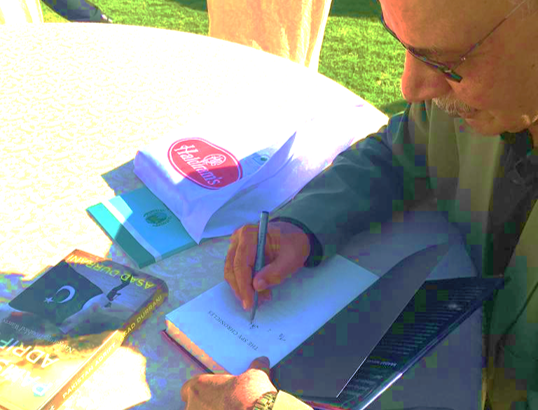
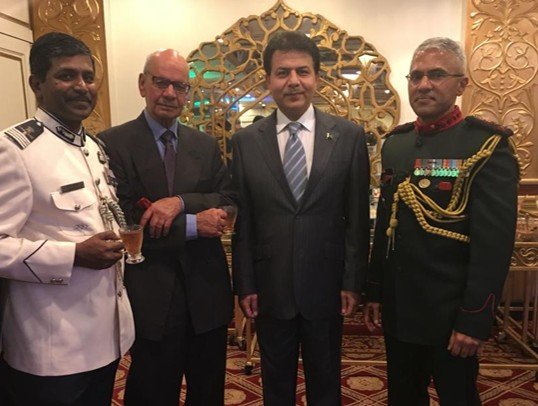
As India’s Defence and Military Advisor at the High Commission in Islamabad (2017—2019), I built the intellectual foundation for what became #PakistanLiesDeceitDeception, not a slogan but a structured analytical framework for reading Pakistan’s decision-making before it becomes visible in headlines. Later, as GOC Srinagar Sub Area (2020-22), I used that same framework operationally, helping shift the narrative in Kashmir from “Azadi” and “Pakistan se Rishta Kya? La Ilaha Illallah!” toward integration with India.
That framework rests on deep subject-matter grounding: the Quran and political Islam, the history of the Two-Nation Theory and its throughline into both Pakistani identity and Kashmiri separatism, and a decade-plus of tracking Pakistan’s India strategy since 2006. My core thesis, developed and tested over years in the country, is that Pakistan’s primary strategic instrument against India is, and will remain, unconventional/ hybrid warfare, not conventional confrontation. Two advantages let me see this clearly from inside Islamabad: I carried none of the emotional baggage of Partition that clouds many Indian analysts, and Pakistan’s own society had just opened up to social media, giving me an unusually direct window into how its military establishment actually operates and communicates internally.
The clearest proof of this framework’s predictive power came in February 2019. While India mourned the martyrdom of 40 CRPF personnel in the Pulwama attack, my team and I had already been tracking a sequence of 18 related events since December 2018, and had concluded, ahead of the news cycle, that the attack was a deliberate attempt to shape the outcome of India’s upcoming general election. Multiple Pakistani and foreign contacts had independently told me that the Pakistani establishment wanted a change of government in Delhi, specifically of Prime Minister Modi.
On 18-19 February 2019, from Dubai Airport (on my way to attend the Aero India Show in Bengaluru), I transmitted that assessment to the High Commissioner, who was then in India for consultations, to Army leadership, and to contacts in the National Security Council Secretariat.
What followed tested how far a correct assessment travels through a hierarchy under pressure. At the Aero India air show in Bengaluru a day later, I briefed Lieutenant General S.K. Saini, who immediately sent me to Army Chief General Bipin Rawat. General Rawat, mid-protocol at the ministerial dinner, gave me fifteen seconds, then asked me to cut my trip short and meet him in Delhi the next day. On 22 February 2019, four days before the Balakot air strike, I briefed the Director General of Military Operations, recommending an Air Force or Navy-led response rather than a ground-based retaliatory strike by our Army, and asking that all resources be deployed first to verify the Pakistan Army’s posture on the Line of Control.
The one objection raised to that recommendation was escalation risk: could an air strike push Pakistan toward nuclear retaliation? My answer at the time was deliberately precise about its own limits. My inputs point towards as assessment of ‘Pakistan does not possess a functioning nuclear weapons capability’, but I said plainly that I did not have hard evidence to prove it, only enough conviction to recommend proceeding.
My assessment was that Pakistan would, at most, showcase its own air force in response and would not escalate further, and that the real priority was protecting India’s general election from further manipulation, not managing a nuclear scenario I judged to be a bluff. Events validated that call. Prime Minister Modi later confirmed publicly, in a May 2019 interview with TV journalist Rajat Sharma, that Pakistan had indeed massed forces expecting a ground response, which is why India’s Balakot strike caught it unprepared.
That same judgement was tested again, at far higher stakes, when India used the BrahMos missile against Pakistan in 2025. Where Balakot tested whether Pakistan would escalate to conventional retaliation, BrahMos tested the nuclear question directly, and again no nuclear response came. Read together, the two events are the strongest available evidence for the position I took in 2019: Pakistan’s nuclear threshold has functioned, for years, more as a deterrent than as a credible red line, a bluff that two separate Indian strikes, six years apart, have now each called and found empty.
The through-line across both events is the transferable skill: reading an adversary’s real capability and real intent correctly, early enough and precisely enough for that read to change a real decision. It is the exact discipline that think tanks, media organisations and risk-exposed businesses need in a geopolitical risk analyst or strategy director, not just in a uniform.
I first met Major General Sanjay Vishwasrao at a seminar in Agartala on “Lasting peace in North East India”, where he graciously gave me a platform to address a large gathering of Indian Army Personnel. A profoundly down-to-earth humanitarian with a secular outlook, he visited my home and church in Fiangpui, earning our deep affection. His “One Tribe One India” initiative fostered peace in Dima Hasao District of Assam, and he led the “Save Our Culture and Heritage” project preserving our Biate Tribe’s Lungzubels (stone jars). Later, as an Associate NCC Officer, I was inspired anew when he headed the NCC Directorate in Delhi cultivating integrity among cadets. The man who encouraged the Kashmiris to embrace Tiranga after abrogation of Art 370 and gave us “Once a Cadet, Always a Cadet” will, I am fully sanguine, keep serving our nation faithfully and sincerely for years to come.

We met Brigadier Shri Sanjay Vishwasrao in 2015, when he was posted at Haflong as the Brigadier of 22 Sector Assam Rifles. Haflong is the headquarters of Dima Hasao District in the state of Assam. It is a beautiful hill station with a population of approximately 50,000 even today.
Dima Hasao was a strife-torn district then. Due to insurgency problems, peace was far gone. There were communal clashes too, just like in Manipur today. The district, which was known for its uniqueness, had seen its various tribes, who used to live peacefully together, become divided. People wanted peace, but there was hardly anyone who dared to step forward and speak up for peace and brotherhood.
But then, we were introduced to Brigadier Vishwasrao and saw how Brigadier Sir personally pushed every effort to bring people together. He and his boys did everything, from being a lasting presence to building peace in the district.
Be it the ‘Three Sisters Ride’, with the tagline ‘Ride for Unity and Peace’, covering the states of Assam, Meghalaya and Mizoram, or the monolithic stone jars, which had become a subject of interest, it was Brigadier Vishwasrao Sir who first brought them to light. The festivals introduced to draw attention to these historic places continue to this day.
He launched a unique campaign called ‘Dima Hasao-19 Unity’ (Unity of 13 Tribes and 6 Non-Tribes, One Dima Hasao and One Trust). The whole town of Haflong was in a festive mood during those times. Haflong Town is called ‘Mini Switzerland’, and indeed, it started to take that shape. He brought a healing touch with his ‘All Tribes, One India’ strategy.
The Judima Festival, Amur Falcon Festival, Jatinga Festival, Save Haflong Lake Campaign, Bushu Dima celebrations, pre-Christmas celebrations, and creating awareness about the Jatinga Bird Mystery are a few instances I can still remember, in which the Assam Rifles participated fully under the command of Brigadier Vishwasrao Sir.
He was deeply connected with the people. His return gift of Tricolour gamchas in exchange for the tribal gamchas that tribals gifted him formed a strong bond among all the tribes, and between us tribal people and the Assam Rifles. He also installed a ‘Dima Hasao-19 Unity Post’ in the centre of Haflong Town. It has the gamchas (scarves) of all the tribes and non-tribes, with two Tricolour gamchas on both sides. This symbol of unity and brotherhood had a huge impact on all tribal and non-tribal people of Dima Hasao District.
Peace followed, and it helped tribal community leaders themselves step forward and stand their ground against extortion by insurgents.
Brigadier Vishwasrao Sir’s initiatives of improving the Maibang Stone House and developing a museum for the Dimasa Tribe have been further developed by the Assam and NCHAC Governments into Ranachandi Park and the Dimasa Heritage Museum and Dishru Research Centre.
Brigadier Sir was, and continues to be, a true friend of the tribal hill people of Northeast India.