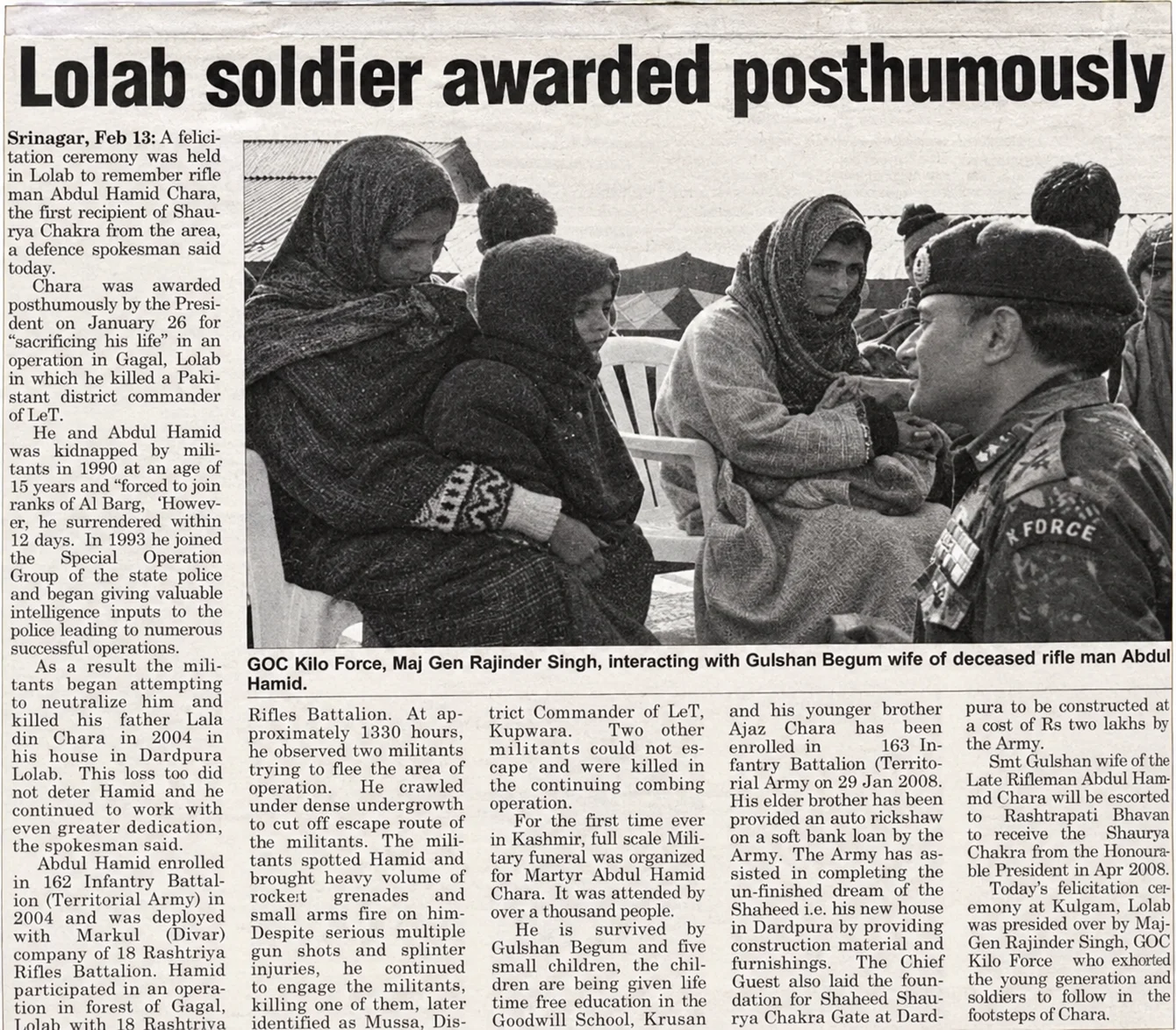
‘People of Lolab have voted for India in plebiscite 2010’ transformed 18 RR, suffering from the causes and effects of suicides by two soldiers and an officer, to win the trust of the people, kill 26 terrorists and win the Army’s team/ unit award in 2009. The resulting peace spared its 1,200 soldiers from Lolab for the Line of Control to strengthen the counter-infiltration grid.
26
Army Commander’s Unit Award, 15 January 2009
Ashok Chakra and Shaurya Chakra (one each); Sena Medal to me
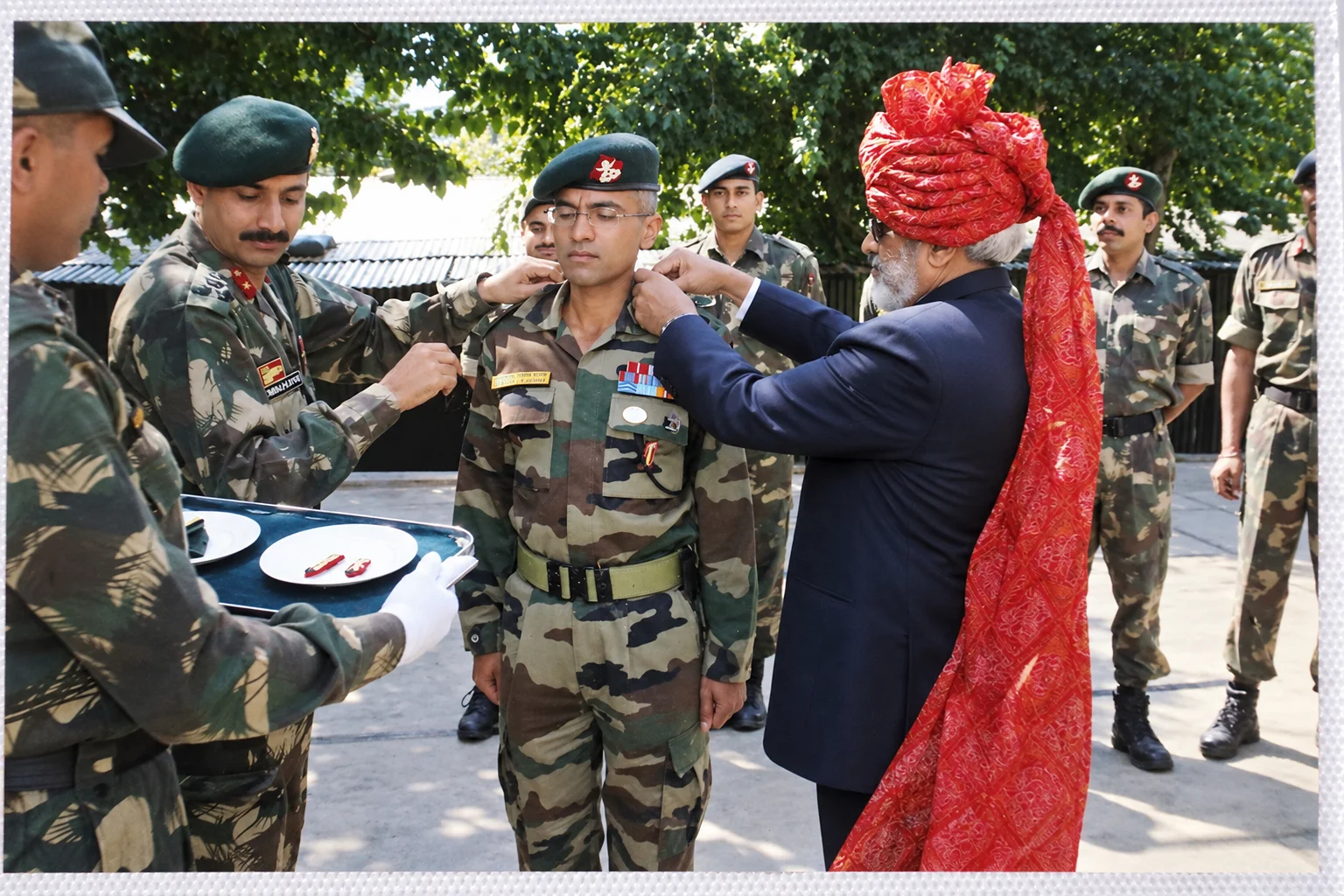

Lieutenant General Deepak Summanwar, Colonel of the Rajputana Rifles Regiment, asked me to take over 18 Rashtriya Rifles (18 RR) as its new commanding officer (CEO), a unit reeling from the causes and effects of suicides by two soldiers and an officer, and allegations of a fake encounter. I volunteered immediately, giving up my father’s own unit in Jaipur, a peace station, to lead 18 RR. In October 2006, I set a vision that had no precedent in Northern Command (Jammu & Kashmir): “The people of Lolab have voted for India in plebiscite 2010.” Strategic communication became the main effort.
The strategy, drawn from John Boyd, William Lind and General Stanley McChrystal, targeted the terrorists’ real support base: the people, not just their weapons. It was a hard sell to 1,200 soldiers trained to see every villager as a threat, and my grip on organisational change management was tested for months before it held.
As we out-manoeuvred rather than out-fought the terrorists and their supporters, the locals began handing us real intelligence. Night-vision technology and a decade of encounter data let us cycle through Observe-Orient-Decide-Act loops faster than the terrorists could react, while a strict zero-civilian-collateral-damage rule kept every decision correctly oriented. Getting soldiers to trust unarmed villagers enough to operate in small teams was tough. Even tougher was training soldiers, accustomed to counting exchanges of fire with terrorists as an achievement, not to fire unnecessarily or kill fellow soldiers through friendly fire. Strict control of the trigger finger empowered us to operate in small teams at faster speeds; first by day and then, even at night illuminated by our night vision devices used to their optimum.
The results spoke for themselves.
We killed 26 terrorists in 24 months. The last major counter-terrorist operation, which killed four terrorists, required just two hours and 70 rounds of AK-47 ammunition. Major Rajesh Singh won a Shaurya Chakra for it.
More importantly, when Pakistan-sponsored stone-pelting swept the Kashmir Valley in 2008, our area was the one place it did not reach. Major General V.S.S. Goudar, then General Officer Commanding of Kilo Force, refused to believe the reports, arrived to check, and found our soldiers playing cricket with the same young men rumoured to be throwing stones. And when I reported to Chinar Corps Commander Lieutenant General Mukesh Sabharwal that we had neutralised 26 terrorists but deliberately let 180 potential terrorist engagements go, to protect civilians or because the terrain made them unsafe, he was stunned to learn that restraint, not body count, was the metric of which I was proudest.
The unit won its Unit Appreciation on 15 January 2009, and I won my Sena Medal for Distinguished Service.
In 2022, sixteen years after I took leadership of 18 Rashtriya Rifles in Lolab as a colonel, I returned to Lolab as a Major General, welcomed by old friends in a valley now needing just two Army posts, down from nine in 2006: proof the peace had outlasted the person who built it.
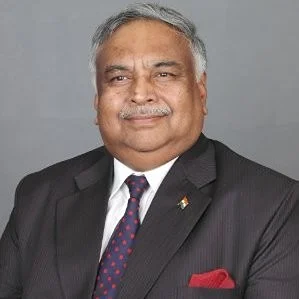
In 2006, I asked Sanjay to volunteer for something few officers would — command of 18 Rashtriya Rifles (Rajputana Rifles), a unit reeling from three soldier suicides. He didn’t hesitate, even giving up his own Rajputana Rifles battalion in a peace station in Rajasthan to take on a troubled unit in the counter-terrorism theatre of North Kashmir. I knew the man; I didn’t know he’d deliver this fast. He gave 18 RR a vision that brought peace to Lolab and rebuilt the unit itself as an effective team. By January 2009, that same unit stood decorated with the Army Commander’s Unit Appreciation — he delivered exactly what I expected, and then some more.
He never called himself our Commanding Officer. He was our Leader in Charge. And in 2006, he set before us a vision that left every officer in the unit stunned: that the people of Lolab would vote for India in a plebiscite in 2010. For a valley that had known little but suspicion and violence, it sounded impossible. But as we watched him pursue it, relentlessly and without pause, our doubt turned into belief.
What set Major General Sanjay Vishwasrao apart was that he never worked at just one level. He could outmanoeuvre and neutralise terrorists with the utmost economy of force, and at the same time carry out the slower, harder work of winning the people away from the cause of azadi and the terrorists who enforced it. He thought and delivered simultaneously at the tactical, operational and strategic levels, a rare combination I have seldom seen since.
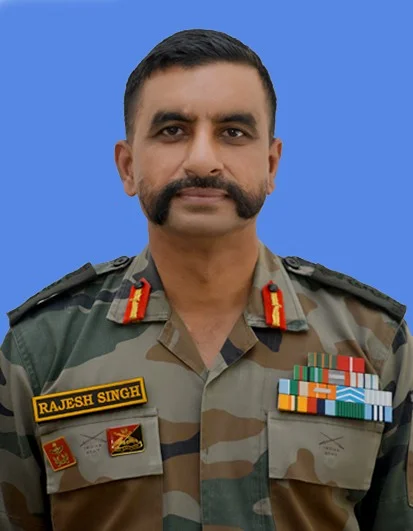
My own Shaurya Chakra, earned with 18 Rashtriya Rifles, rests on his strategic brilliance. I carried out the action; he had already done the thinking that made it possible. In a single hour, my team neutralised four terrorists using only 70 rounds of AK-47 ammunition, with zero collateral damage. That outcome was built on everything he had put in place: the trust of the people, which gave us human intelligence; manoeuvre that trapped the terrorists in the chosen area; and training in controlled, precise fire. That day, hard work also met fortune. Two of my soldiers survived direct hits of terrorist fire, one saved by his bulletproof patka and the other by his bulletproof jacket.
Years later, through his updates from Srinagar in 2021 and 2022, I watched that same vision, unchanged in its logic and grown only in scale, unfold across the whole of Kashmir: Lal Chowk reclaimed without bloodshed, and a peace that reached ordinary Kashmiris in a way few thought possible. I was not surprised. He had done it before, and he did it again, the same way.
I look forward to the second edition of Lage Raho Leadership, the story of our journey together with 18 Rashtriya Rifles in Lolab, North Kashmir.
I first met Sanjay as a young Commanding Officer of 18 Rashtriya Rifles in Lolab. It was the first time I had heard a Colonel speak of vision and manoeuvre in counter-terrorist operations, and I confess I returned sceptical — such talk is easy, delivery is not. He went on to prove himself right on every parameter that mattered: terrorist kills, zero stone-pelting, a high voter turnout, not one negative incident. His book on that unit, Lage Raho Leadership, is an accurate account of exactly what I saw unfold in Lolab with my own eyes. That was 2007. I have, in one way or another, watched Sanjay almost continuously ever since. I liked his professionalism enough to pick him as my Colonel Military Secretary when I commanded a Strike Corps — he agreed on one condition, that I teach him mechanized Strike Corps operations in return, and I did. After I retired, I visited him in Assam in 2015 and saw him building tribal culture into a strategy for peace. Then in 2016, he was selected as India’s Defence & Military Advisor in Pakistan — the very appointment I had held myself, a decade before him. Only the best Brigadiers are ever selected for that posting, the toughest diplomatic assignment India has, and his tenure fell in a period that made it tougher still: the “No Terror & Talks” policy, the Pulwama–Balakot conflict, and the abrogation of Article 370. I visited him again in Srinagar in 2021, to see the start of his Tricolour Revolution Strategy, for which General Bipin Rawat had selected him. He delivered again — bloodless peace in Kashmir. Across all these years and all these postings, what has struck me most is Sanjay’s ability to grasp a complex situation, design a real solution, and then actually execute it. He truly lived up to his surname, Vishwasrao, and delivered on each task to his best ability — and to my utmost satisfaction. To get it done, and done well, Sanjay has been my go-to officer for a long time. Through every bit of it, Sanjay and Sanjeevani have remained, in a way I have rarely seen at that level, simply humble — and that, in the end, is the rarer achievement..